


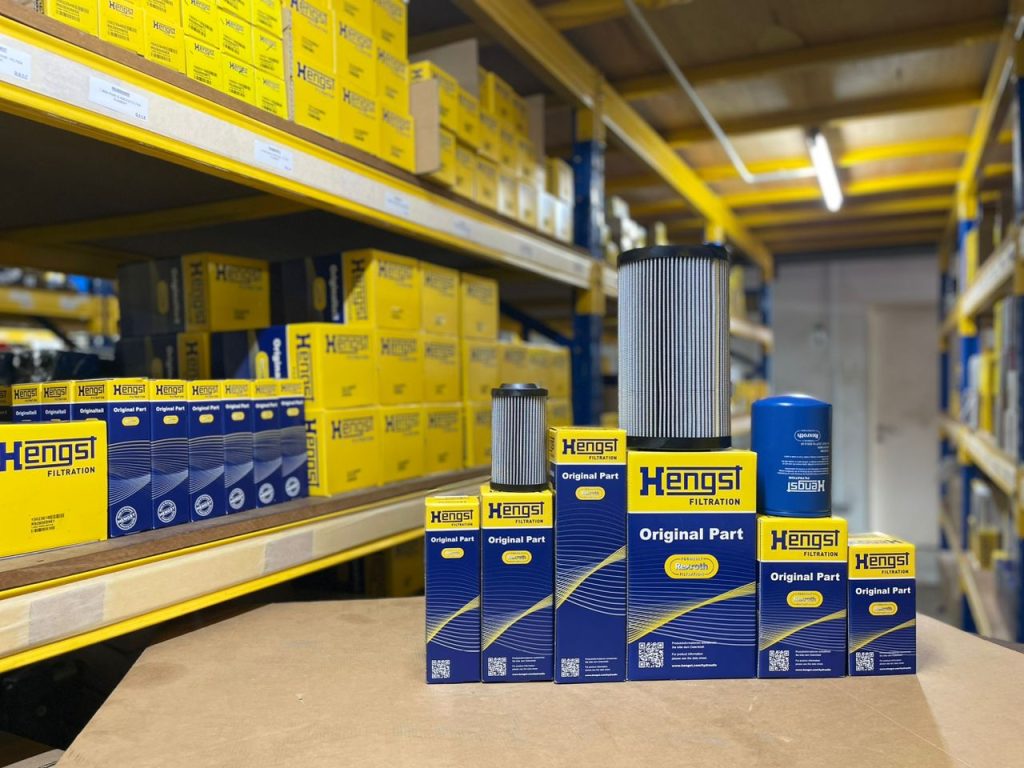
Somewhere between seventy and eighty per cent of hydraulic failures trace back to contaminated fluid. The filter element is the cheapest component in the system and the one that decides how long the expensive ones last.
Twin Hydraulics Engineering supplies Hengst and Bosch Rexroth elements across Malaysia, along with the housings they fit. As a Hengst Competence Partner for hydraulic filters and systems, we cross-reference elements from other makes so you are not locked to whatever was fitted originally.
Cross-referenced to any brand
Give us the element number stamped on the old cartridge and we will match it on dimensions, micron rating, beta ratio and collapse pressure — Parker, Hydac, Donaldson, Pall, Mahle, Filtrec, Internormen, MP Filtri and the rest. You get a like-for-like element without paying the OEM's replacement-part margin, and without guessing whether it will fit.
Micron rating and beta ratio
A micron rating alone tells you little. The beta ratio is what matters: β10 ≥ 200 at 10 µm means the element removes 99.5% of particles that size on each pass. We supply elements across the full range, from 1 µm right up to 800 µm — and finer is not automatically better.
Fine, coarse, and why coarse is not worse
— 1 to 10 µm — servo and proportional circuits, high-pressure piston pumps, and offline polishing loops where the target cleanliness class is demanding
— 10 to 25 µm — general industrial and mobile return-line and pressure-line duty; the bulk of what most plants use
— 25 to 150 µm — coarse protection, lube circuits and gear oil, and systems running high-viscosity fluid where a fine element would simply blank off
— up to 800 µm — suction strainers and mesh elements protecting a pump inlet, and gearbox and industrial oil applications where the job is to stop debris, not to polish
Put an over-fine element in the wrong position and it blocks, opens its bypass and passes unfiltered fluid — worse than the coarse element you replaced. Position decides rating.
As a rule of thumb, servo and proportional valves demand the cleanest fluid, piston pumps next, and simple gear-pump circuits are the most tolerant. Match the element to the most sensitive component in the circuit.
Position in the circuit
— Suction — coarse protection for the pump inlet only; too fine here causes cavitation
— Pressure line — protects sensitive valves directly downstream
— Return line — catches wear debris before it reaches the tank; the most common position
— Offline or kidney loop — continuous polishing, independent of the working circuit
When to change
Follow the clogging indicator rather than the calendar, and always change elements after a component failure — debris from a failed pump will destroy its replacement. Send the element code, or the housing code if the element is unmarked, and we will identify it.
Frequently asked
Can you cross-reference a filter from another brand? Yes. Give us the original element number and housing details and we will match dimensions, rating and collapse pressure.
Do you supply Hengst as well as Rexroth? Yes, we carry both lines, and can source Parker, Hydac and other makes where you prefer to stay with the original.
What is the coarsest element you can supply? Up to 800 µm — suction strainers, mesh elements and coarse industrial and gear-oil filtration, as well as fine elements down to 1 µm.
What element suits a proportional valve circuit? Typically a fine element with a high beta ratio in the pressure line, plus a return-line element. We can advise against your target cleanliness class.
Bosch Rexroth filter numbers
Hengst acquired Bosch Rexroth's hydraulic filtration business, so a Rexroth filter part number now maps to a Hengst one. Look yours up on our Bosch Rexroth to Hengst cross-reference — 7,932 parts, with type designations and dimensions.
See also Hydraulic Inline Filter and our filtration system design and rental service.
Showing 1–9 of 4165 results

